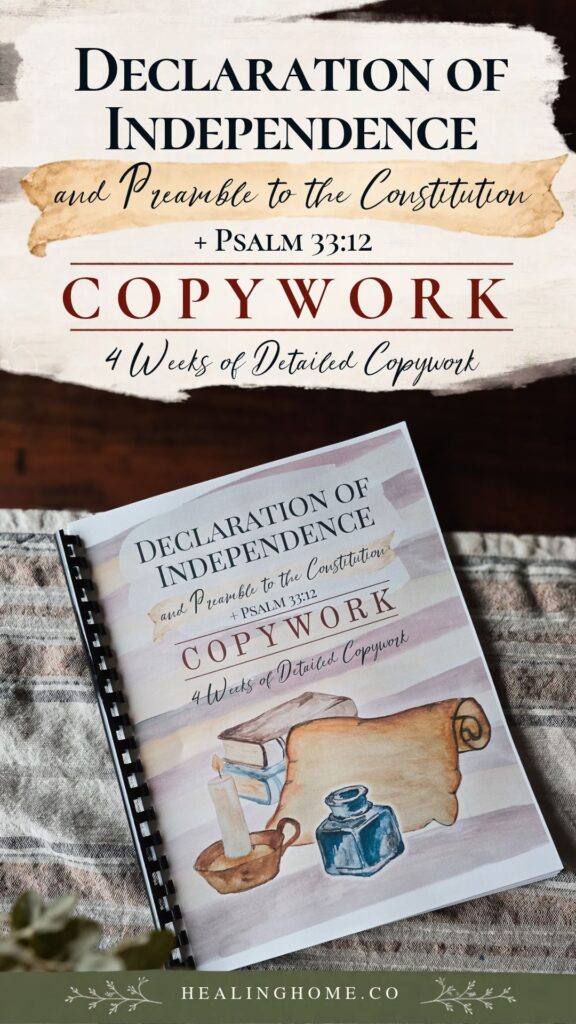
Bring American history to life with Declaration of Independence handwriting practice, Constitution copywork, Scripture, and Charlotte Mason-inspired picture studies for your homeschool.
There is something special about slowing down long enough to write out the words that shaped our nation’s history. We’ve been leaning into a Charlotte Mason idea of copywork for the last couple of years and I really do love the practice. In a world where so much of our learning happens quickly, I love inviting my children to sit with an important passage and carefully copy it onto the page. It is a simple practice, but one that brings together so much.
As a homeschool mom of five and a former teacher, I am always looking for ways to make our everyday lessons more purposeful. I also want our education to leave room for the kind of careful attention that is so easily lost when we rush from one subject to the next.
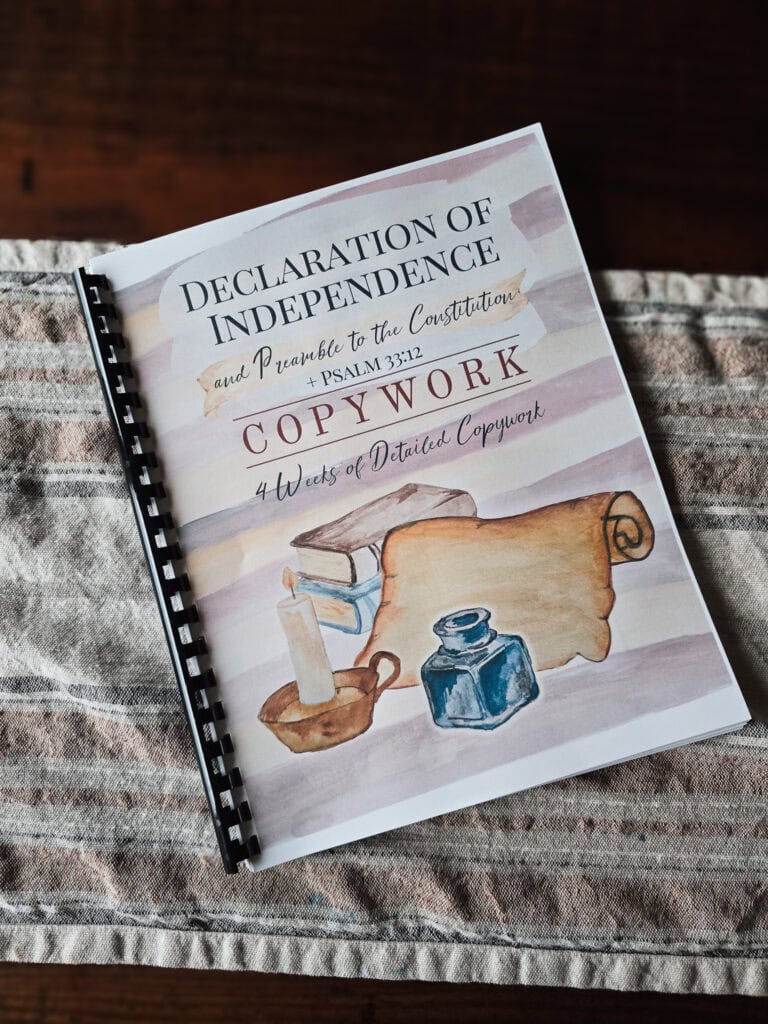
That is one reason I created my series of copywork booklets. I couldn’t find anything that seemed robust enough for me when it came to copywork, so I just decided to create my own! They have morphed and changed over the last two years, and this Declaration of Independence and Constitution Copywork is the first that I’ve strayed from exclusively using Scripture in our copywork. This four-week printable combines American history, handwriting practice, Scripture copywork, and picture study in a resource designed to help families slow down and enjoy the process of learning together.
If you want to skip directly to the freebie or download click the buttons below. Gumroad is the only place where the freebie is avaliable.
Whether you are studying the founding fathers, exploring the origins of the United States Constitution, or simply looking for a meaningful addition to your Charlotte Mason homeschool, I hope this resource will be a blessing to your family.
This page may contain affiliate links. To view my full affiliate link disclosure, click here. There are Amazon affiliate links in this post. As an Amazon Associate, I make a small commission from Amazon links in this post. Find our privacy policy, terms of service, and more information about user data by visiting the links above.
Why I Love Copywork in Our Homeschool
Copywork has become one of my favorite ways to incorporate language arts into our homeschool. Rather than asking children to complete endless handwriting exercises, copywork invites them to study a carefully chosen passage and reproduce it with attention to spelling, punctuation, capitalization, and letter formation.
Charlotte Mason described transcription as “slow and beautiful work.” I love that phrase because it reminds me that education does not always need to be about completing more pages or moving through lessons as quickly as possible. Sometimes, the most valuable work happens when a child gives his attention to one small task and learns to do it well.
The Declaration of Independence
We are starting a unit study about US history from 1763-1815, which essentially is the founding of the United States. I’m very excited about this unit as I think this time in US history is fascinating!
As we work through our Revolutionary War unit study, I wanted to give my boys the opportunity to spend time with the words that helped shape the founding of our nation. The Declaration of Independence, adopted by the Second Continental Congress on July 4, 1776, announced that the thirteen American colonies considered themselves free and independent states, no longer under the authority of the British Crown. Its opening words, “When in the Course of human events,” introduce one of the most significant documents in American history.
Written primarily by Thomas Jefferson, the Declaration explains why the representatives of the United Colonies believed separation from Great Britain had become necessary. It speaks of the laws of nature, unalienable rights, and the pursuit of happiness, declaring that governments receive their just powers from the consent of the governed. These principles provide a wonderful starting point for discussing the ideas behind the American Revolution and the founding fathers’ understanding of liberty and government.
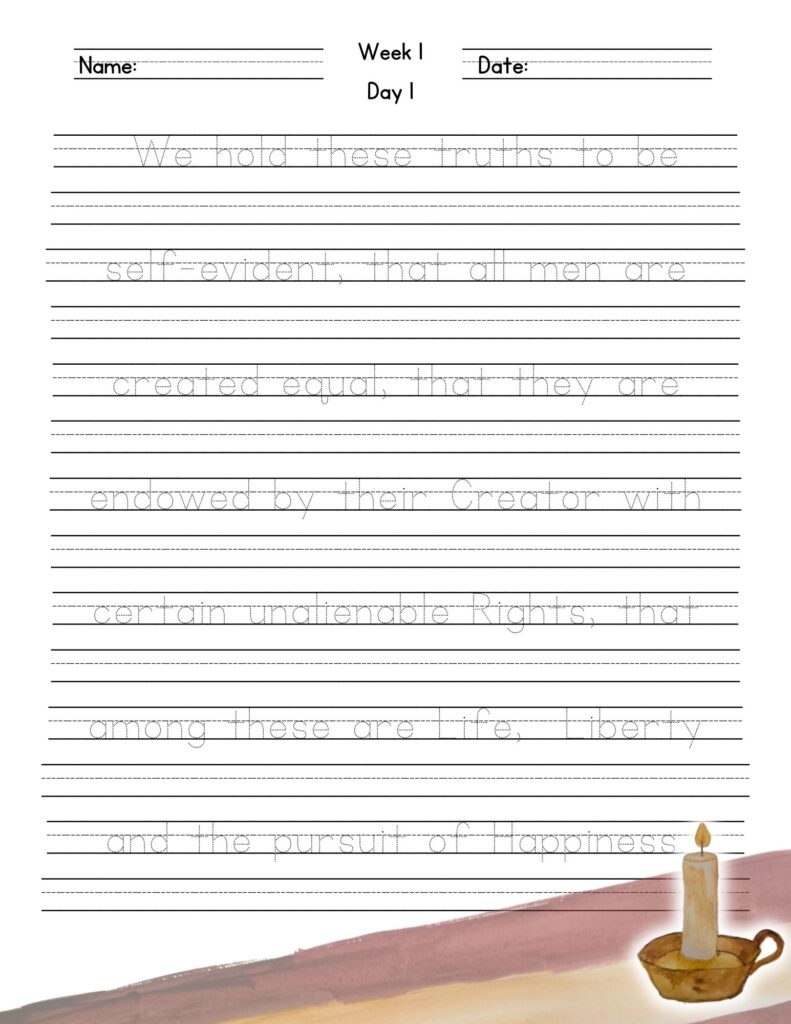
This is the excerpt from the Declaration that I am including in the copywork booklet:
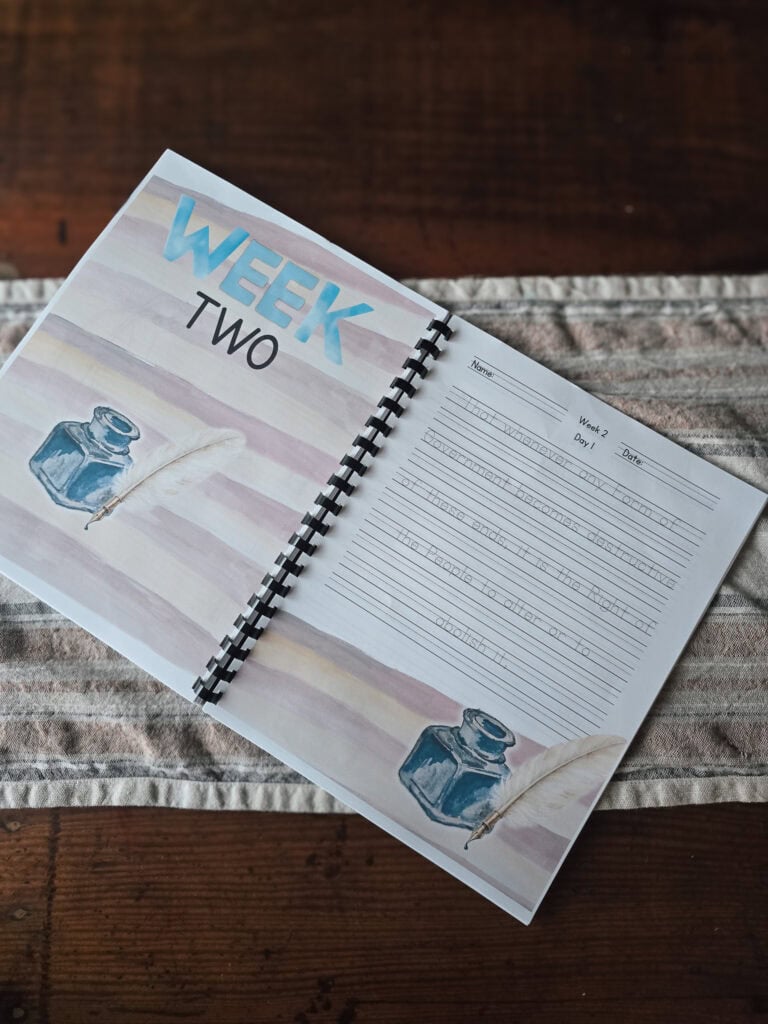
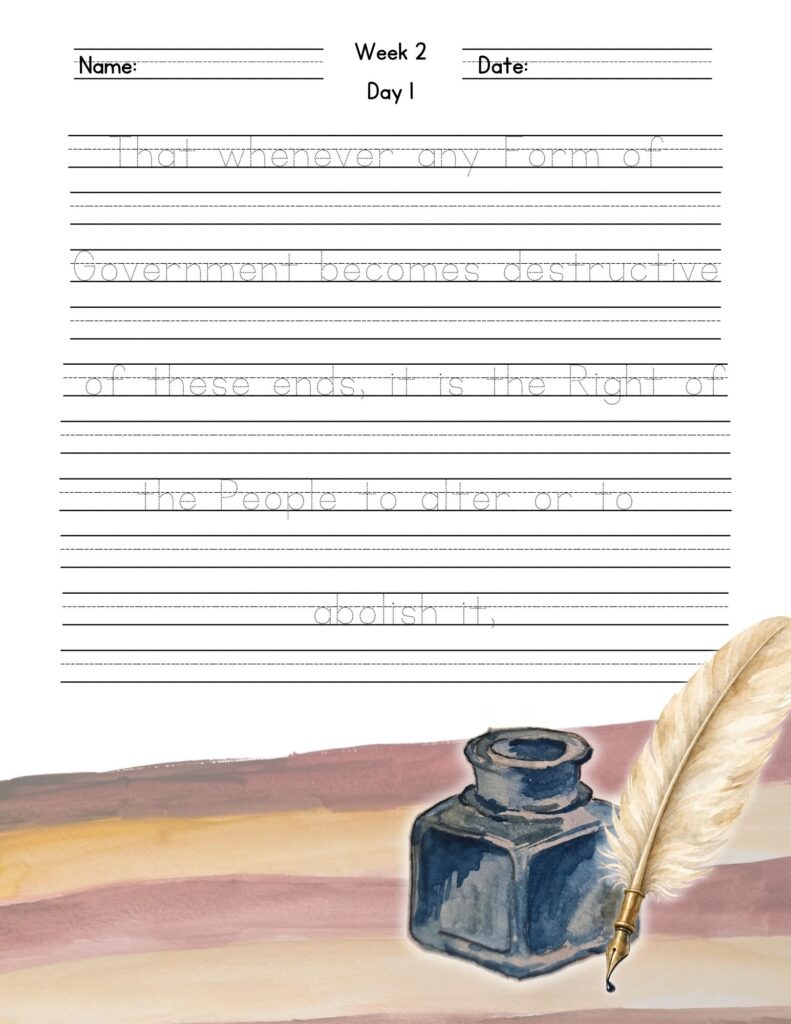
We hold these truths to be self-evident, that all men are created equal, that they are endowed by their Creator with certain unalienable Rights, that among these are Life, Liberty and the pursuit of Happiness.–That to secure these rights, Governments are instituted among Men, deriving their just powers from the consent of the governed, –That whenever any Form of Government becomes destructive of these ends, it is the Right of the People to alter or to abolish it, and to institute new Government, laying its foundation on such principles and organizing its powers in such form, as to them shall seem most likely to effect their Safety and Happiness.
Declaration of Independence
The Preamble to the Constitution
As our Revolutionary War unit study continues into the beginnings of the United States government, the next natural step is to explore the Constitution. Winning independence was only the beginning. The new nation still needed a lasting framework for governing itself, and the United States Constitution, written in 1787, established the structure and purposes of the federal government.
I chose to include the Preamble because its opening words, “We the People,” introduce the purpose behind this foundational document. The Preamble describes the goals of the new government: to establish justice, ensure domestic tranquility, provide for the common defense, promote the general welfare, and secure the blessings of liberty. These are important ideas for children to encounter as they begin learning about American government and the principles that shaped our nation’s founding.
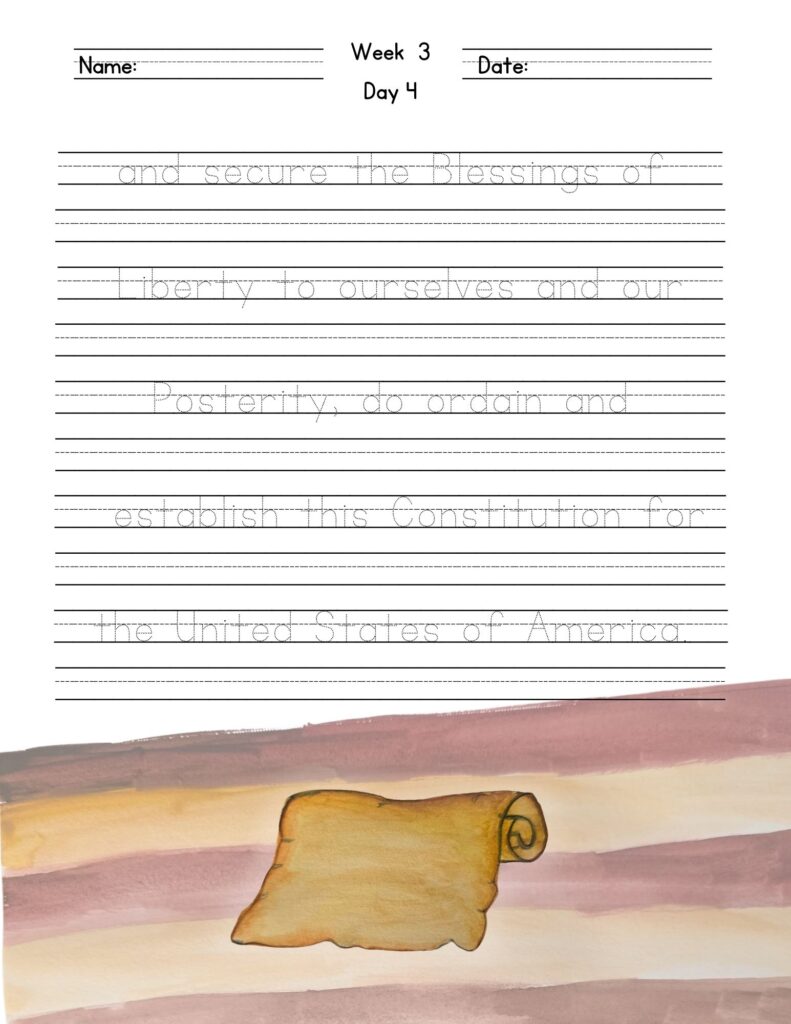
We the People of the United States, in Order to form a more perfect Union, establish Justice, insure domestic Tranquility, provide for the common defence, promote the general Welfare, and secure the Blessings of Liberty to ourselves and our Posterity, do ordain and establish this Constitution for the United States of America.
Preamble to the Constitution
Bringing American History to Life Through Picture Study
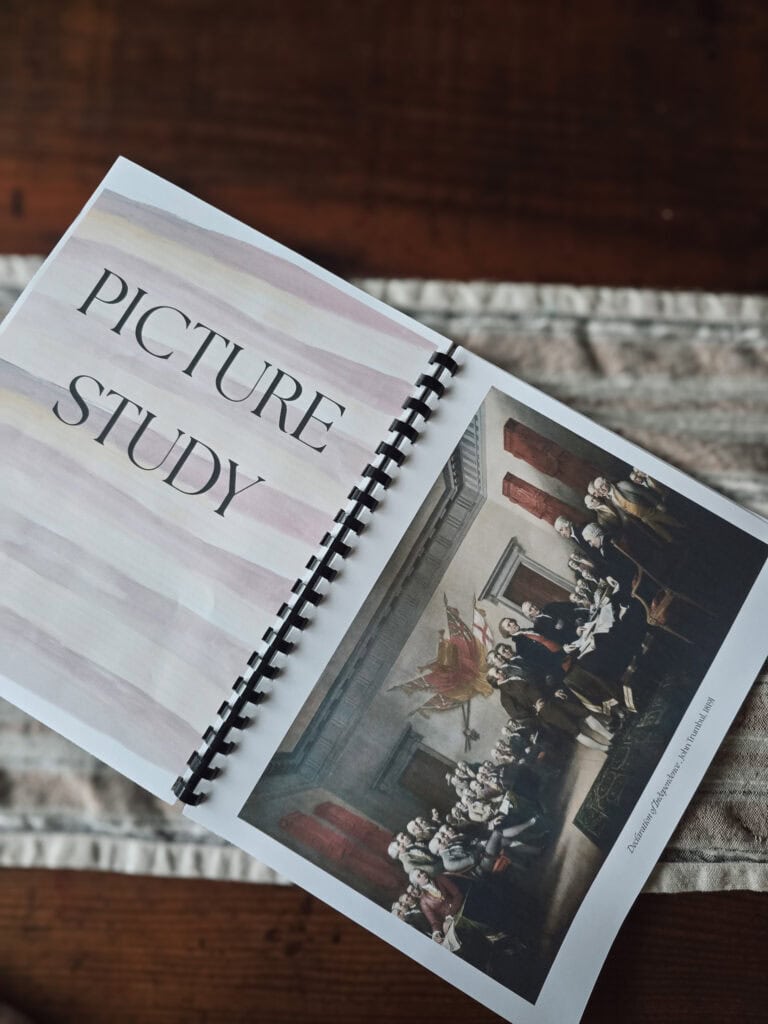
One of my favorite additions to this copywork workbook is the picture study component. I wanted this resource to be more than a collection of handwriting pages, so I included four lessons that invite children to look closely at historical artwork and consider the stories behind it.
Picture study is a natural companion to a Charlotte Mason-inspired education. Rather than simply telling children what to notice in a painting, we give them time to observe it for themselves. They can examine the details, describe what they see, ask questions, and gradually develop a deeper appreciation for art.
Each week features a different historical image.
The first lesson features John Trumbull’s Declaration of Independence, painted in 1819. The painting depicts the presentation of the proposed declaration to the Continental Congress and offers an opportunity to discuss the people involved in this pivotal moment.
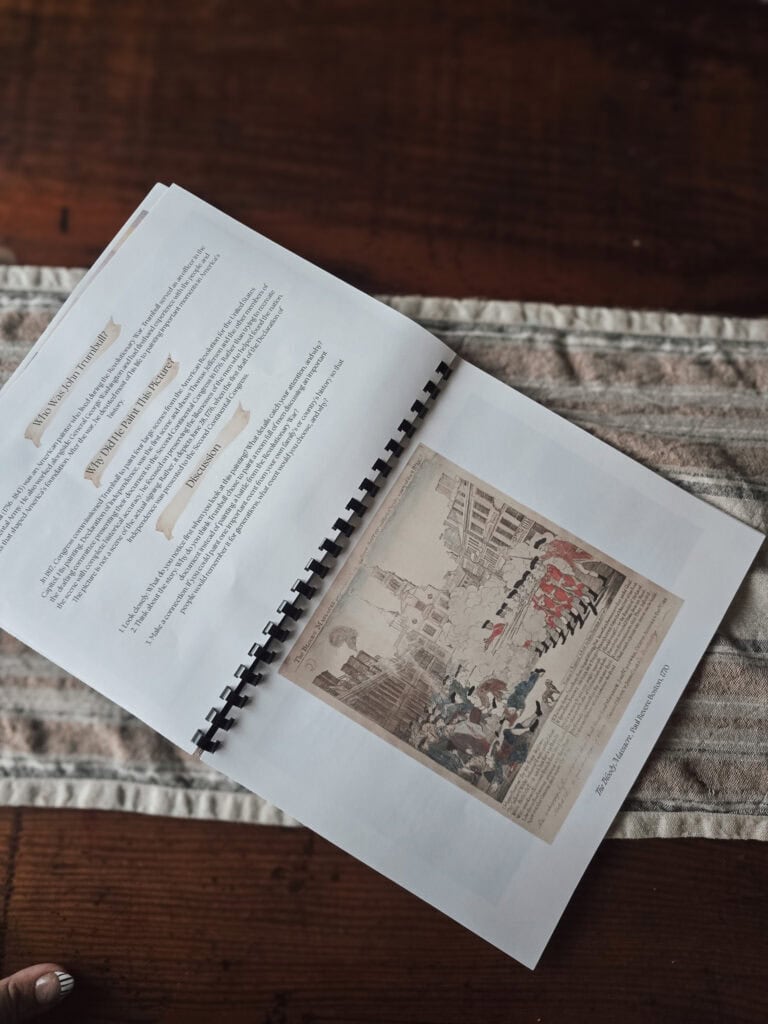
The second lesson features Paul Revere’s The Bloody Massacre, his famous 1770 engraving depicting the Boston Massacre. This image provides a starting point for discussing how visual art can communicate a particular interpretation of historical events and influence the way people understand a story.
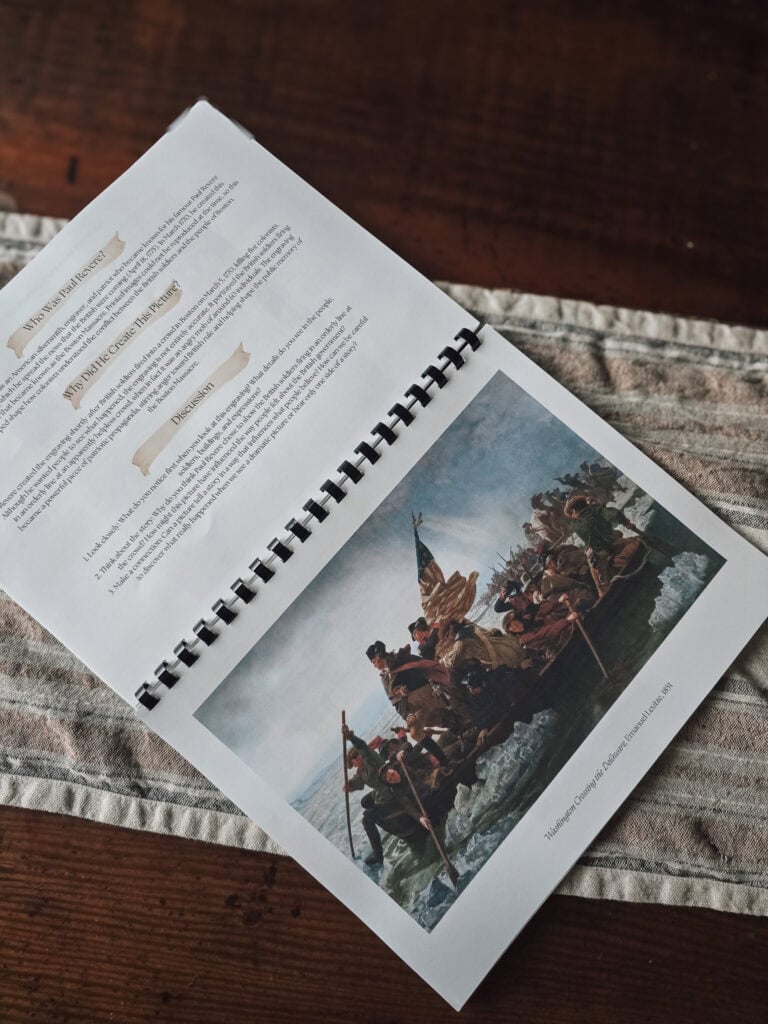
The third lesson explores Emanuel Leutze’s Washington Crossing the Delaware, painted in 1851. The dramatic scene portrays General George Washington and his men crossing the river on Christmas night in 1776, before the American victory at Trenton. The painting was created decades after the event, making it an interesting example of how artists revisit history to communicate courage, perseverance, and national identity.
The final lesson features Join, or Die, the political cartoon associated with Benjamin Franklin and published in 1754. The divided snake became a memorable image of the need for unity among the colonies. Children can consider how a simple illustration can communicate an idea and why unity became such an important theme in early American history.
Each picture study includes background information and discussion questions to help families engage with the artwork together. I love the opportunity to bring history, observation, conversation, and art appreciation into one lesson.
A Gentle Four-Week Approach to Learning
I designed this workbook to be manageable for real homeschool days. As a mother of five, I know that a beautiful educational plan still needs to work within the ordinary rhythms of family life. Some mornings are peaceful, and others require a little more flexibility.
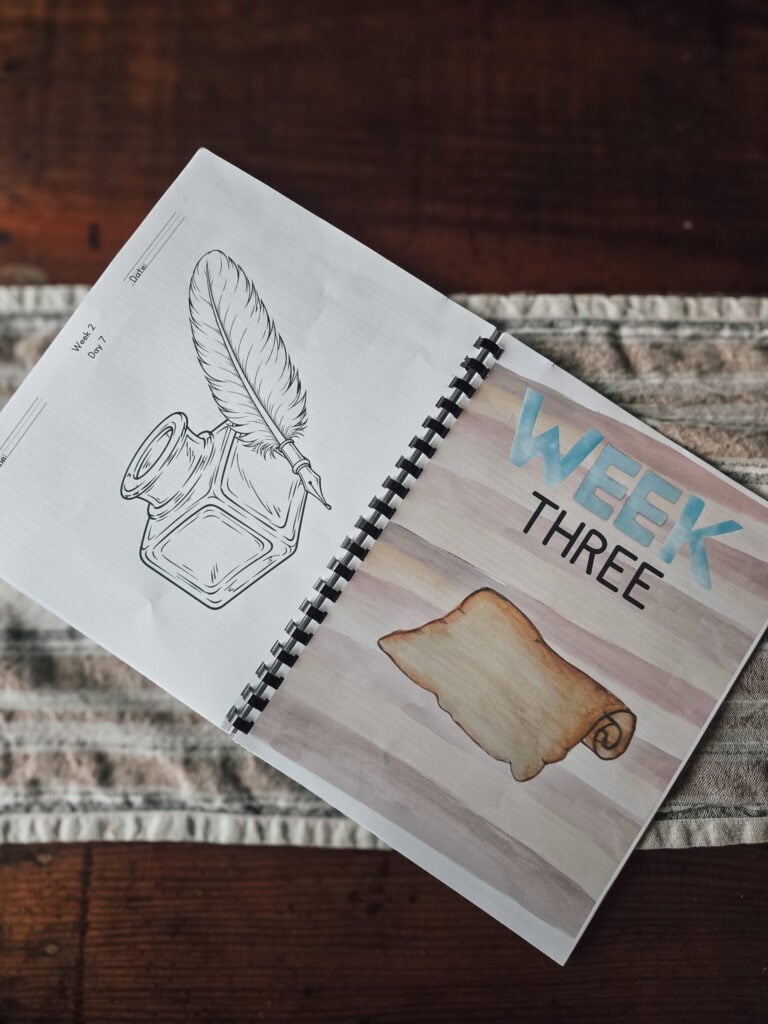
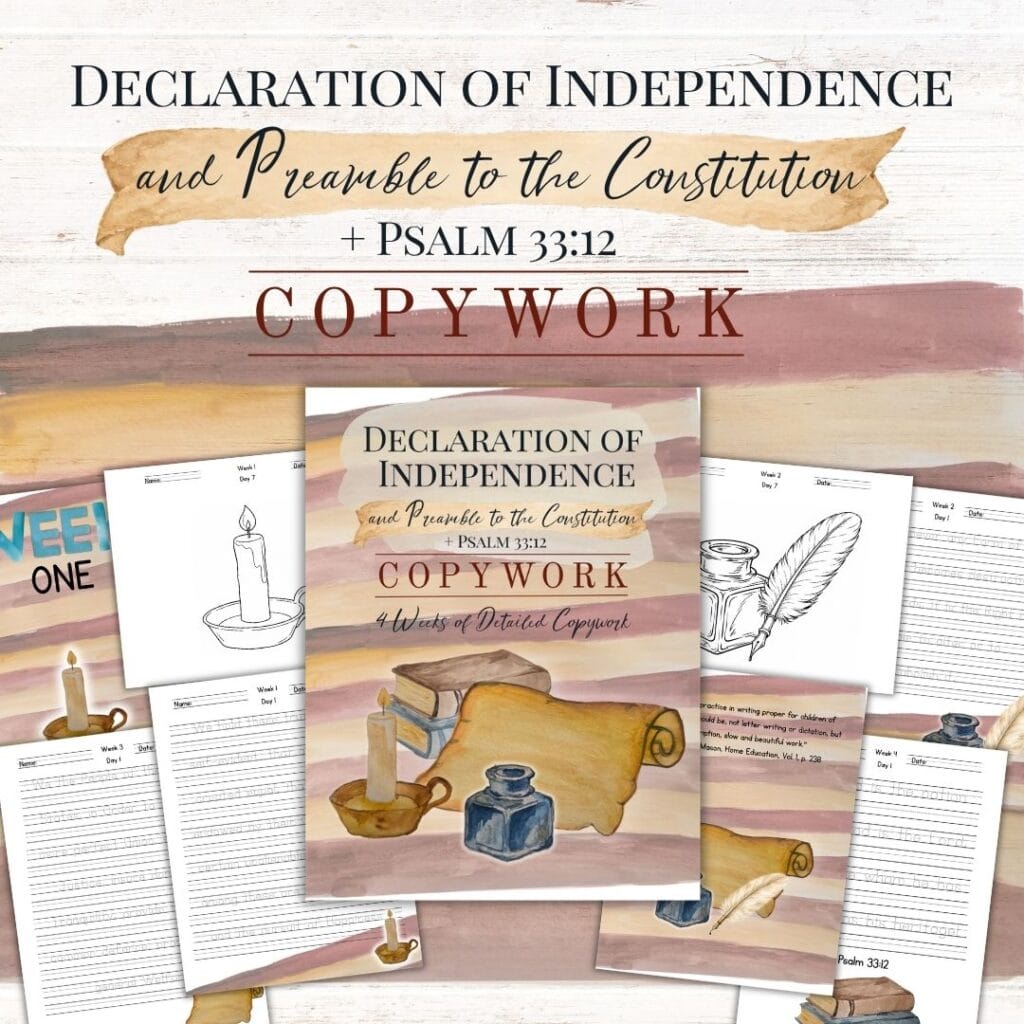
The workbook includes 58 printable pages with four weeks of detailed copywork and four picture study lessons. The first two weeks focus on excerpts from the Declaration of Independence, the third week features the Preamble to the Constitution, and the fourth week turns to Psalm 33:12.
I especially wanted to include Scripture because faith is an important part of our family’s education.
“Blessed is the nation whose God is the LORD, the people whom he has chosen as his heritage!” Psalm 33:12(ESV).
Studying the founding documents of our country and copying a passage of Scripture are not the same exercise, but I appreciate the opportunity to bring both into our homeschool. We can learn about the people and events that shaped American history while remembering that our ultimate hope is not found in a nation, a government, or any earthly system. Our hope rests in the Lord.
Creating a Beautiful Resource for Homeschool Families
When I create printables for Healing Home, I want them to feel inviting without distracting from the learning itself. I love watercolor artwork, soft colors, and historical illustrations that help establish the atmosphere of a lesson while leaving the words at the center.
For this workbook, I painted the vast majority of the watercolor artwork by hand and designed the booklet myself. I used AI for a few limited elements: the feather, the word “week,” and one banner. The remaining illustrated elements were painted by me, and the complete booklet layout and design are my own. You can find an entire AI disclosure in the in the opening pages of the booklet.
I wanted the resource to feel warm and thoughtful, with a gentle visual style that complements the idea of slow and beautiful work. My hope is that these pages will be useful in your homeschool while also being something you enjoy bringing to the table each morning.
As with my Scripture copywork booklets, this resource grew out of my desire to make everyday learning more meaningful. I love creating materials that help families combine practical skills with ideas worth thinking about and words worth remembering.
Where to Purchase
If you are planning an American history study or looking for a meaningful addition to your Charlotte Mason-inspired homeschool, I would love for you to explore this four-week copywork workbook.
The 58-page printable includes excerpts from the Declaration of Independence, the Preamble to the United States Constitution, Psalm 33:12, and four historical picture study lessons. It combines handwriting practice, American history, Scripture, and art appreciation in one resource that can be used at a gentle pace.
Important – I have a FREE versions avaliable to download on Gumroad with the first pages, picture study, and first week of copywork.
You can incorporate it into your existing history curriculum, use it during Morning Basket, or set aside a few minutes each day for careful transcription. It is designed to complement your homeschool rather than require you to rebuild your schedule around it.
I hope this resource encourages your children to slow down, notice the beauty of carefully written words, and develop a deeper appreciation for the history they are studying. More than anything, I hope it helps you create meaningful moments of learning together, one page at a time.
If you enjoy these resources, you can also explore my collection of Bible verse copywork booklets and other Christian homeschool printables. I create these resources with families like yours in mind, and it is a joy to share a little of what we are learning in our own homeschool.
Keep learning, keep growing, and keep making room for the slow and beautiful work of education.
Don’t Forget to Pin for Later!