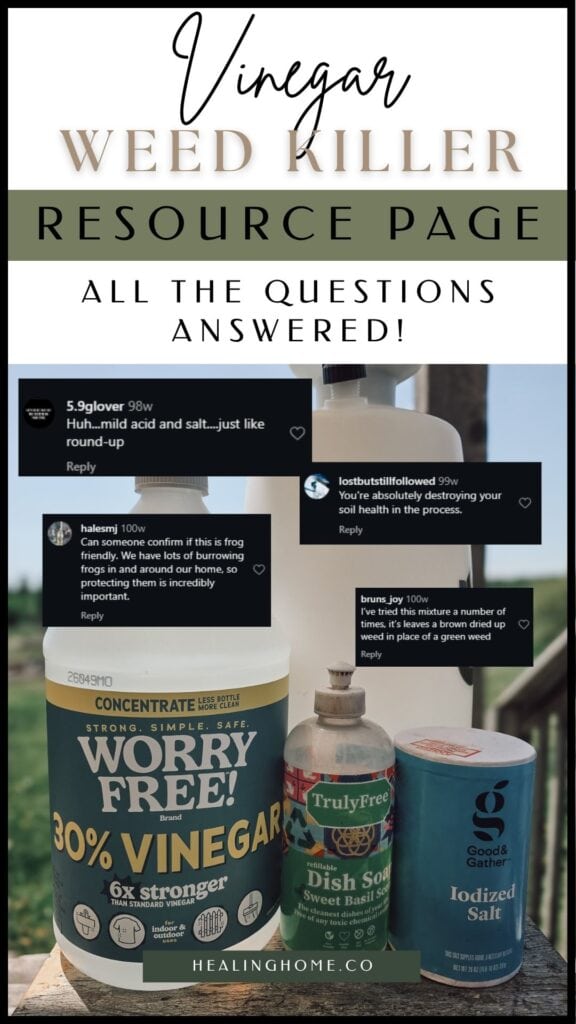
Homemade Vinegar Weed Killer made with 30% vinegar, salt, and dish soap. I’ve used this natural weed killer recipe since 2015 and recently discovered one tweak that makes a huge difference.
If you’ve been around here for a while, you probably already know that I prefer simple, practical solutions around the homestead whenever possible. And when it comes to weeds? They are the bane of a gardener in full swing.
I’ve been using this Homemade Vinegar Weed Killer since 2015, and after nearly a decade of trial and error, I can confidently say this is still my go-to method for keeping weeds under control around fence lines, gravel areas, walkways, and problem areas where hand weeding just isn’t realistic.
In fact, a reel I shared on Instagram about this exact recipe unexpectedly went viral, reaching over 6 million views. Apparently, a lot of us are looking for a natural(ish) alternative to commercial weed killers. But after reading thousands of comments, I realized something important: people want honest answers about what actually works.
HUGE NOTE – The wording I used on the reel was incredibly poor. Actually, downright stupid. People were very quick to point out my flaws in grammar and wording. I’m aware of it and, quite honestly, was surprised by how thin my skin was at the time. I felt like the world’s biggest idiot. Hence, the reason it took me 2 years to put together this resource page. Hopefully, this time around, my skin has gotten a bit thicker.
I’ve tweaked this homemade weed killer recipe quite a bit, and recently I discovered the strength of the solution makes a big difference. If your vinegar weed killer recipe has failed in the past, there’s a good chance the vinegar concentration was simply too low.
Before we jump in, I want to be honest about something: this is not a perfect solution, and it may not be right for you. Vinegar can affect the nearby soil and potentially impact good microbes if overused. But personally, we still believe chemical weed killers like Roundup are not the answer either. For our family, reducing harmful chemicals matters.
That said—and this may surprise you—the best sprayer I’ve ever used is actually the Roundup sprayer. I’ve used it exclusively for the last four years because it sprays evenly, lasts forever, and simply works. (Sometimes the commercial product is worth it, even if what goes inside it is not.)

This page may contain affiliate links. To view my full affiliate link disclosure, click here. There are Amazon affiliate links in this post. As an Amazon Associate, I make a small commission from Amazon links in this post. Find our privacy policy, terms of service, and more information about user data by visiting the links above.
Table Of Contents
- My Homemade Vinegar Weed Killer Recipe (Updated After 10 Years)
- Why 30% Vinegar Makes a Huge Difference
- Does Vinegar Weed Killer Ruin Soil?
- Why We Don’t Use Roundup (But Still Love Their Sprayer)
- Is Homemade Vinegar Weed Killer Safe for Chickens, Ducks, and Geese?
- Tips for Using Homemade Vinegar Weed Killer Successfully
- My Viral Vinegar Weed Killer Reel (6 Million Views!)
The following is for entertainment purposes only. Do your own research when it comes to anything you spray on your property.
My Homemade Vinegar Weed Killer Recipe (Updated After 10 Years)
After years of tweaking, this is the exact recipe I keep coming back to.
The main ingredient here is the high-strength vinegar. I used to use regular household vinegar (the kind sitting in your pantry), but switching to 30% acetic acid vinegar made a night-and-day difference in weed-killing powers.
The dish soap helps the vinegar solution stick to the leaves instead of rolling off, while the salt helps dry out persistent weeds.

Homemade Vinegar Weed Killer
omemade Vinegar Weed Killer made with 30% vinegar, salt, and dish soap. This has been my go-to method for tackling stubborn weeds since 2015—and after years of tweaking, I finally found what works best.
Materials
- 1 gallon of 30% vinegar
- 1 ½ cups salt
- 3 tablespoons dish soap
Tools
- Large sprayer
- Funnel (optional)
- Gloves and protective clothing
Instructions
- Step 1: Add the Vinegar - Pour 1 gallon of 30% vinegar into a large garden sprayer.
- Step 2: Add the Salt - Add 1 ½ cups salt to the vinegar. Stir or gently swirl until mostly dissolved.
- Step 3: Add the Dish Soap - Pour in 3 tablespoons of dish soap. Gently mix to combine, being careful not to create too many suds.
- Step 4: Choose the Right Day - Apply on a hot, sunny day when weeds are completely dry and rain is not in the forecast for at least 24 hours. Sunshine helps strengthen the weed-killing effect.
- Step 5: Spray Thoroughly - Spray weeds until fully drenched, covering both the leaves and the base of the plant.
- Step 6: Repeat for Stubborn Weeds - For stubborn areas or larger weeds, apply a second treatment 1–3 days later. Some weeds may require multiple applications for best results.
Recommended Products
As an Amazon Associate and member of other affiliate programs, I earn from qualifying purchases.


Why 30% Vinegar Makes a Huge Difference
Here’s one thing I wish I had known sooner: white vinegar from the grocery store usually isn’t strong enough.
Most household vinegar contains around 5% acetic acid, which may wilt small annual weeds temporarily but often won’t touch established root systems.
Once I switched to a 30% vinegar solution, the results dramatically improved—especially on stubborn patches of weeds growing along fence lines and gravel. I personally use the Worry Free vinegar, but any vinegar with a concentration for 30% or above will do. Worry Free is also available at places like Menards, which is nice when I want to pick some up while running errands.
We love using Truly Free products around our household, but any dish soap will work. If you decide to order from Truly Free, code HEALINGHOME gets you 30% off!
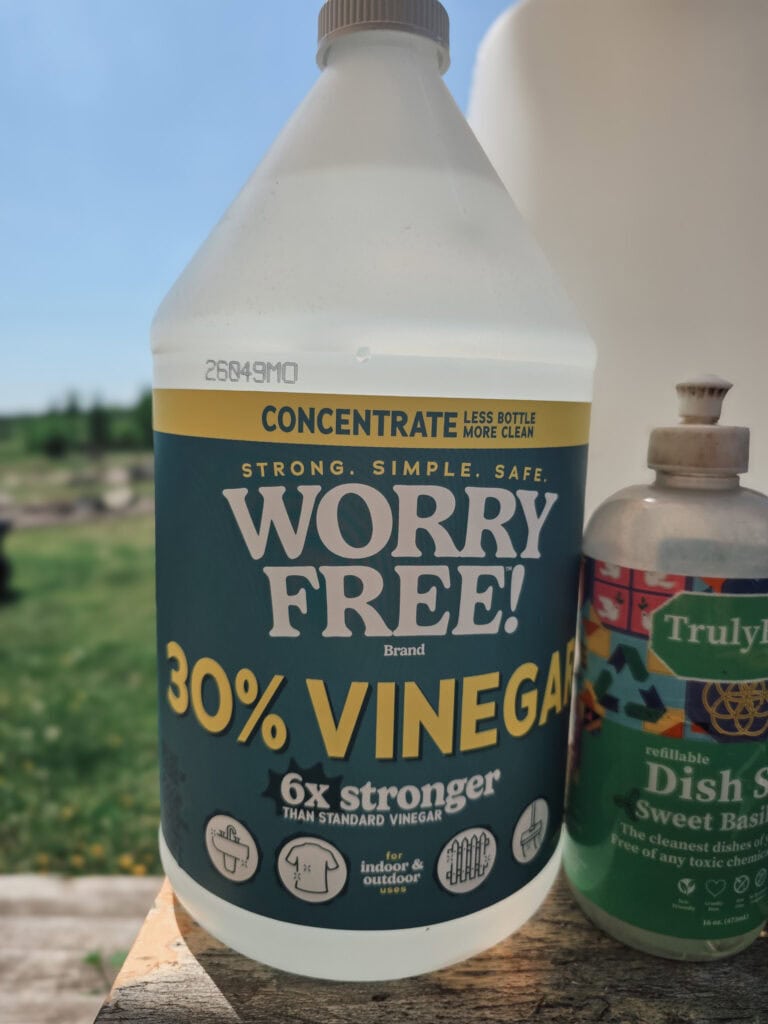
That said, extreme care is needed with stronger vinegar. This is not kitchen vinegar anymore. Wear appropriate PPE, including long sleeves and long pants, and avoid spraying on windy days or near desirable plants.
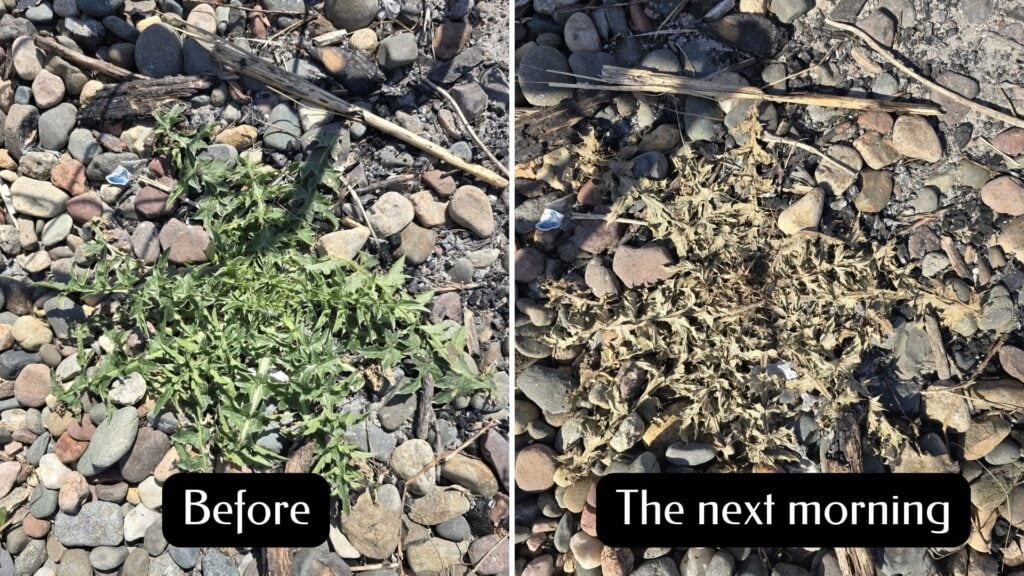
For the best results, spray on a hot, dry sunny day when weeds are bone dry. The sun intensifies the effects and helps dry weeds out faster.

Does Vinegar Weed Killer Ruin Soil?
This is probably the most controversial question I get.
The honest answer? It can affect your soil if overused.
Salt and highly concentrated vinegar may alter the pH of the soil, affect the nearby soil’s microbial community, and harm healthy plants if sprayed carelessly. That’s why I primarily use this in large areas, along fence lines, gravel paths, driveway edges, and places where I don’t intend to grow vegetable gardens or flower beds.
I personally avoid using it near ornamental plants, nearby plants, or places where I want healthy soil biology long term.
If you’re trying to build thriving garden soil with homemade compost and encourage good microbes, this probably isn’t your long-term solution.
Why We Don’t Use Roundup (But Still Love Their Sprayer)
I know this can be a hot topic, but I want to be transparent.
For our family, Roundup is not something we feel comfortable using. We prefer to avoid controversial chemical weed killers and look for more non-toxic ways to manage weeds when possible.
That doesn’t mean I think homemade remedies are perfect either.
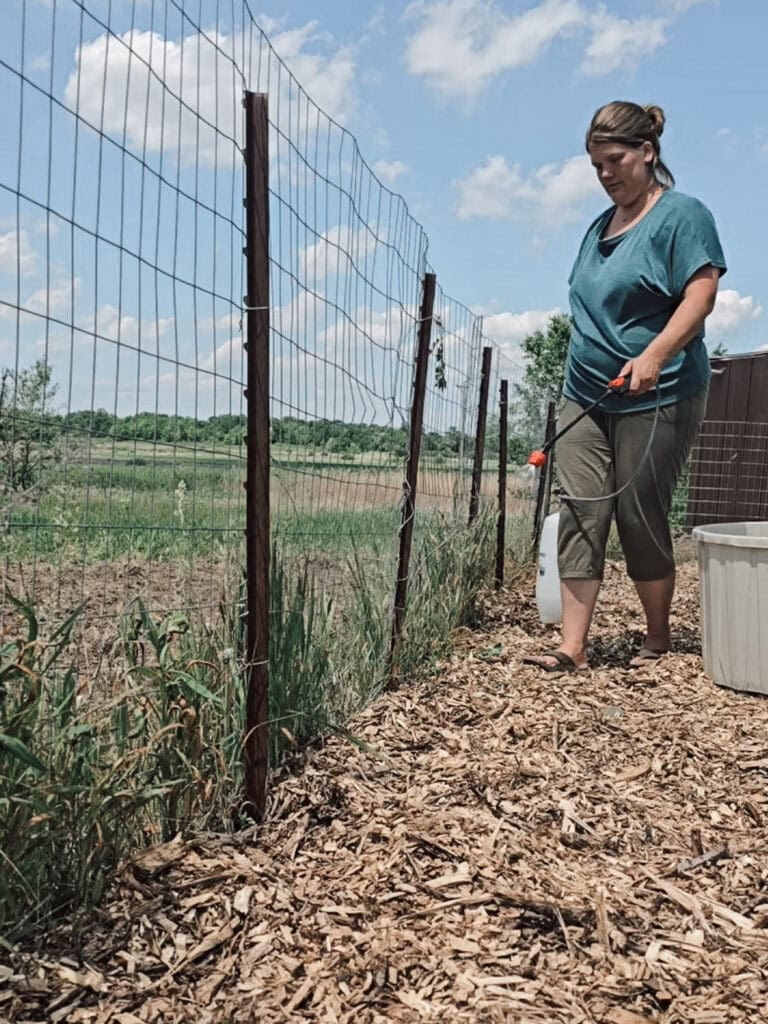
I think weed management often comes down to choosing the best option for your own family and property. For us, this DIY weed killer feels like the better fit.
Ironically, though? The Roundup sprayer is hands-down the best sprayer I’ve ever owned. I’ve used the same one for four years, and I’ll probably never switch back. It sprays evenly, holds up incredibly well, and makes treating patches of weeds much easier.
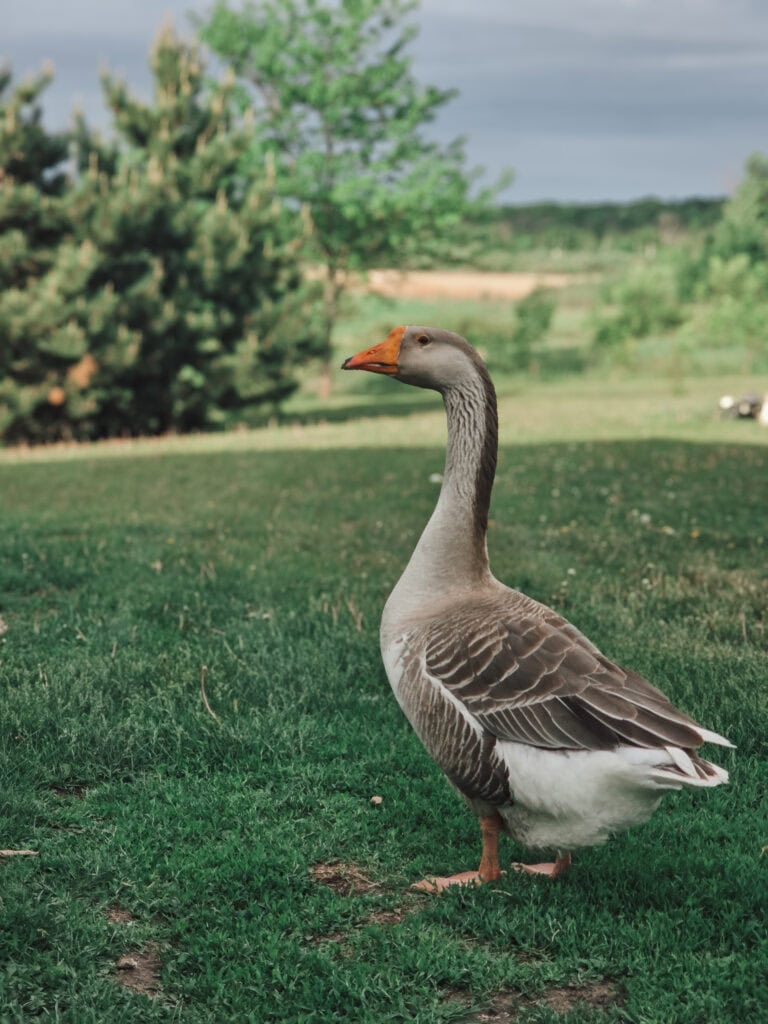
Is Homemade Vinegar Weed Killer Safe for Chickens, Ducks, and Geese?
If you’re anything like us and have animals roaming the homestead, this is probably one of the first questions that comes to mind. The honest answer? I use caution.
Because this recipe uses 30% vinegar, it’s much stronger than regular household vinegar and can irritate sensitive skin, feet, eyes, and respiratory systems if animals come into contact with it while it’s still wet. Personally, I keep our chickens, ducks, and geese away from freshly sprayed areas until everything is completely dry—usually at least 24 hours. I also avoid spraying near water sources, feeding areas, or places where our birds actively scratch and forage.
For us, this homemade weed killer works best in places like fence lines, gravel driveways, walkways, landscaping, and other problem areas rather than heavily trafficked animal spaces.
While we personally feel better using this than many chemical weed killers, I also don’t think “natural” automatically means harmless. Like most things around the homestead, I think it’s about using wisdom and being thoughtful about where and how you apply it.
Tips for Using Homemade Vinegar Weed Killer Successfully
A few things I’ve learned since 2015:
- Only spray weeds when they’re completely dry
- Apply on a dry day with full sun
- Larger weeds may need multiple applications
- Spray both the leaves and the base of the weed until fully drenched
- Grass and stubborn weeds often need 2–3 treatments
- Avoid spraying near desirable plants or vegetable gardens
- Reapply during the growing season as needed
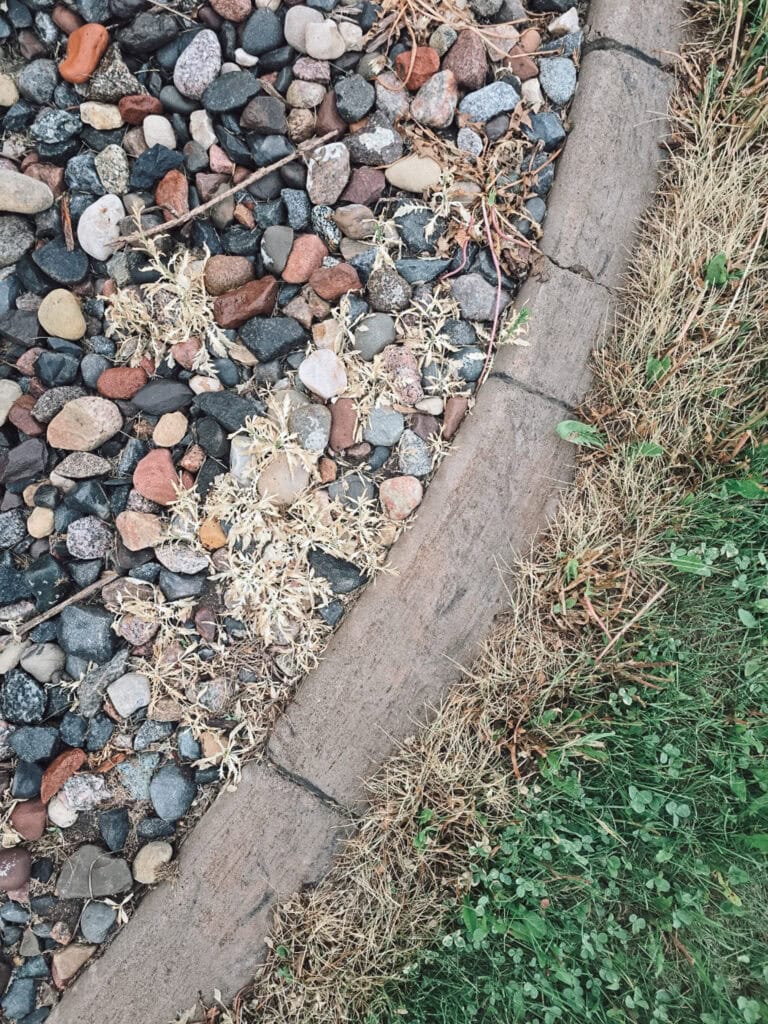
- Yes, it does kill grass!
This isn’t usually a “one spray and done” solution for every group of weeds, but with consistency, I’ve had excellent results.
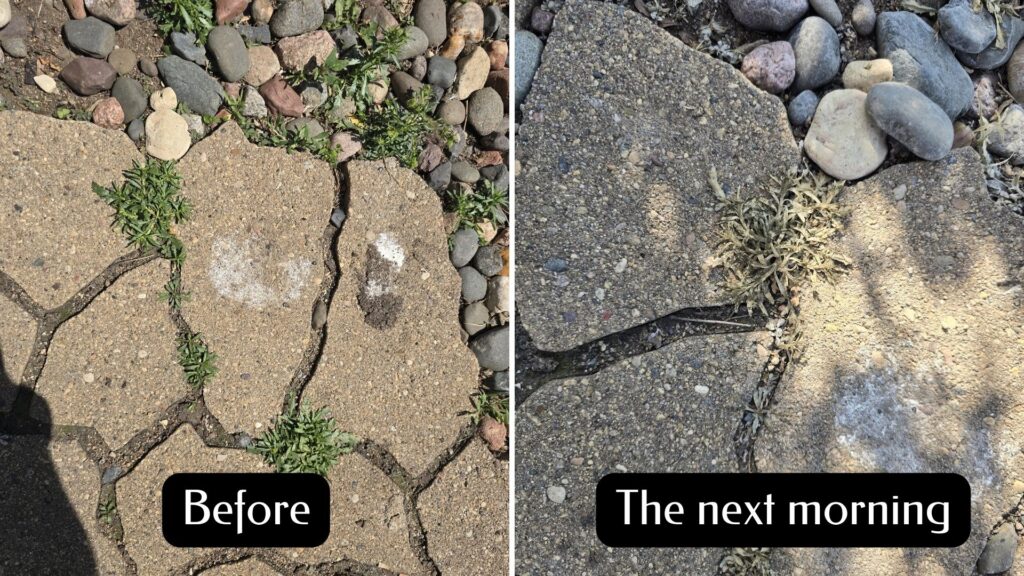
My Viral Vinegar Weed Killer Reel (6 Million Views!)
Last year, I casually shared this recipe in an Instagram reel—fully expecting maybe a few thousand people to see it.
Instead, it exploded to over 6 million views.
I think it struck a chord because so many people are looking for easy ways to reduce harmful chemicals around kids, pets, and homesteads while still dealing with the very real problem of weeds.
You can watch the original reel below.
And yes—the comments section was definitely full of opinions. 😅
A Note on LD50
I think it’s important to talk about something called LD50. It was something that was brought up in the comment section of the viral reel, and it definitely gave me pause because, according to LD50, my homemade weed killer is more toxic than glyphosate.
If you’ve ever gone down the rabbit hole researching ingredients or chemicals (guilty 🙋♀️), you’ve probably come across this term. LD50 stands for “Lethal Dose 50%,” which is essentially a measurement scientists use to estimate how much of a substance would be required to cause death in 50% of a test population. It’s often used as one way to compare toxicity.
Now, I want to say something important here: toxicity is nuanced.
Just because something is “natural” doesn’t automatically mean it’s harmless, and just because something is commonly used doesn’t automatically make it something I’m personally comfortable with using around my family or homestead.
Understanding the chemical makeup of something matters to me.
For example, vinegar is actually pretty simple in composition. Vinegar is primarily made up of water and acetic acid, created through a fermentation process where sugars or starches become alcohol and are then converted into acid by bacteria. At its core, it’s a relatively simple substance—even though at 30% concentration, it still deserves respect and careful handling.
Glyphosate (the active ingredient commonly associated with Roundup), on the other hand, is an organophosphorus compound and a synthetic derivative of the amino acid glycine. Yes, I had to Google that and thoroughly research it, so I’m not above making a mistake on that definition. It functions as a broad-spectrum herbicide designed to kill weeds systemically.
For me personally, I care about more than a single toxicity number. I think about how something works, what it breaks down into, how it interacts with soil, animals, and our home environment, and what level of exposure I’m comfortable with for my family.
That doesn’t mean everyone will make the same choices—and that’s okay.
This homemade vinegar weed killer isn’t perfect, and I don’t believe there is a perfect option when it comes to weed management. But I do think understanding ingredients and making informed decisions matters.
Conclusion
After using this Homemade Vinegar Weed Killer since 2015, I still keep coming back to it because it works, it’s simple, and I feel better about using it around our home than many available weed killers.
Is it perfect? No.
Will it completely replace every weed control method? Probably not.
But for fence lines, gravel, driveways, landscaping around the house, and stubborn patches of weeds, it has been one of the most practical homemade remedies we’ve found.
The biggest lesson I’ve learned over the years is this: 30% vinegar changed everything. If you’ve tried a vinegar weed killer recipe before and felt disappointed, the vinegar concentration may have been the missing piece.
Just use it wisely, spray carefully, and remember that sometimes the goal in homemaking and homesteading isn’t perfection—it’s simply making thoughtful choices for your family.
Don’t Forget to Pin for Later!