Discover practical life skills to teach kids through everyday life, from basic cooking skills and food preservation to resourcefulness, critical thinking, and learning to use what they have.
I’ve been thinking a lot lately about the life skills I want my boys to have when they grow up. As a homeschooling mom, I spend a lot of time thinking about education, but the older my boys get, the more I realize that education can’t simply be about what they know. I want them to become capable, curious people who know how to learn, work, and figure things out when they don’t know the answer.
When we talk about essential life skills, there are plenty of practical things that come to mind: personal hygiene, good manners, communication skills, managing money, doing laundry, and eventually all the skills they’ll need as young adults. Those things matter, but I think there is something underneath all of them that may be even more important.
I want my boys to love learning and have a desire for excellence—to understand that ordinary work is worth doing well. I want them to develop critical and creative thinking so that when they encounter something they don’t know how to do, their first response isn’t, “I can’t do that.” I want it to be, “I wonder how.”
And in a world where almost everything can be purchased, I especially want them to understand that they don’t always have to buy the solution. I’m thankful for modern conveniences and the grocery store, but I don’t want my children to believe every need automatically requires a purchase. I want them to look at what they already have and ask, “What can I do with this?”
To me, that is one of the most important life skills I can give them.
This page may contain affiliate links. To view my full affiliate link disclosure, click here. There are Amazon affiliate links in this post. As an Amazon Associate, I make a small commission from Amazon links in this post. Find our privacy policy, terms of service, and more information about user data by visiting the links above.
- Teaching Life Skills Through Everyday Life
- Life Skills to Teach Kids: Basic Cooking Skills and Preserving Eggs
- Teaching Life Skills Our Ancestors Knew: Understanding Food and Nutrition
- Basic Cooking Skills for Kids: Making Butter, Bread, and Biscuits
- What I Actually Want My Boys to Learn
- What Can I Do With What I Have?
Quick Links from the YouTube Video:
Teaching Life Skills Through Everyday Life
One of the reasons I love homeschooling is that we don’t have to divide our lives into little boxes where school happens at the table and then real life begins afterward. So many practical life skills can be taught right in the middle of everyday life, and children can learn an incredible amount simply by being invited into the work of their family.
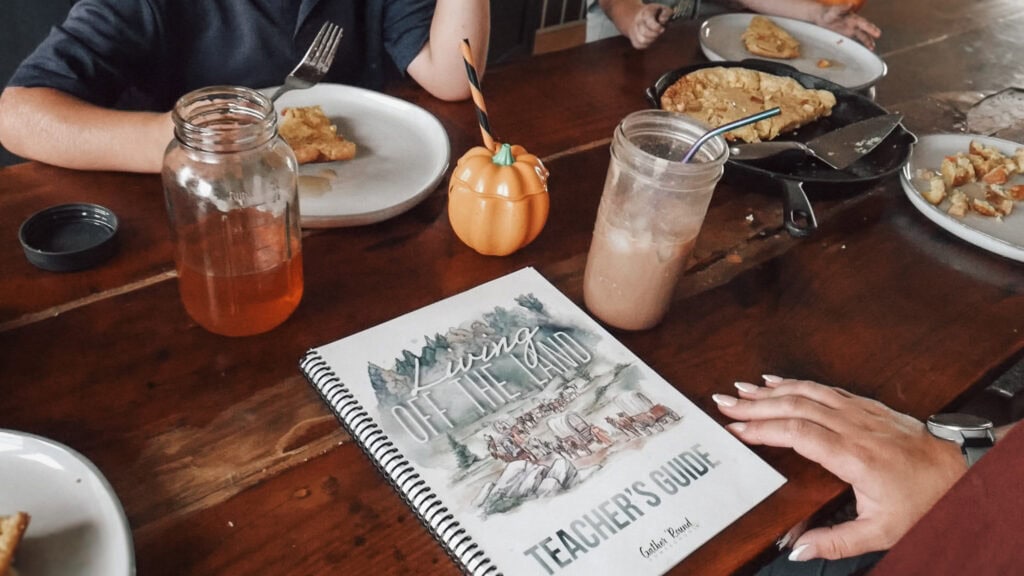
Right now we’re working through our Living off the Land Pioneer Unit, and I love that it gives us opportunities to talk about what people did before they had a grocery store around every corner. But I’m not trying to recreate pioneer life, and I’m not trying to turn my boys into little homesteaders who know how to do everything their ancestors did.
What I am trying to do is help them understand where things come from and how things work. When they actually make something with their own hands, there is often a little light bulb moment that happens, and I love those moments.
The light bulb isn’t necessarily, “Now I know how to make butter.” It’s, “Oh, that’s how butter is made,” or “Oh, we can actually preserve these eggs,” or “I didn’t know we could make that ourselves.” Those moments teach children to ask questions, try new things, and think about problems differently.
I think that’s one of the best things about teaching life skills at an early age. Young children don’t need complicated projects or elaborate lessons to begin developing practical skills. Simple tasks like measuring, stirring, cleaning up, caring for animals, or helping prepare a meal give younger children a lot of practice with responsibility and independence.
Those small things add up.

Life Skills to Teach Kids: Basic Cooking Skills and Preserving Eggs
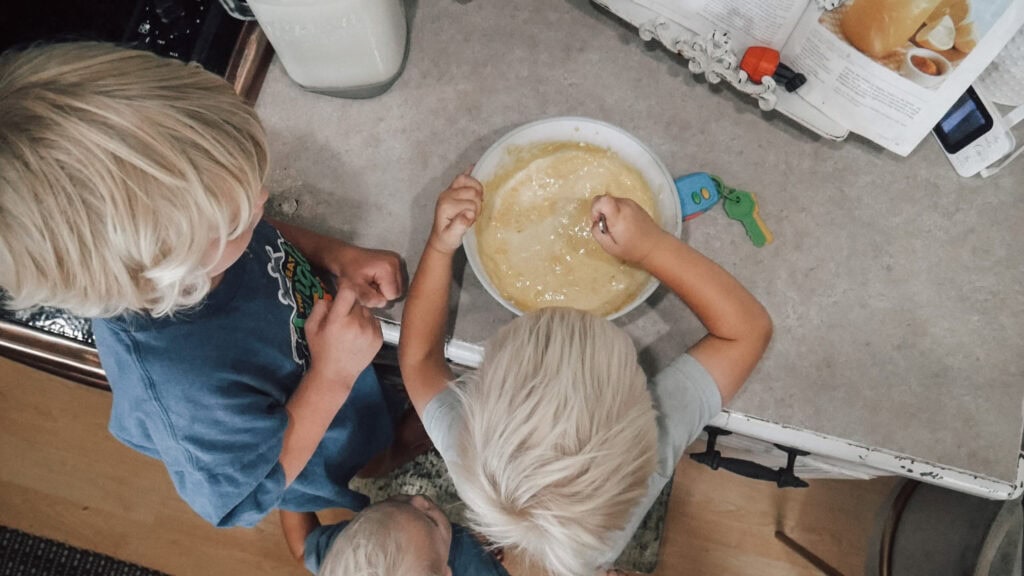
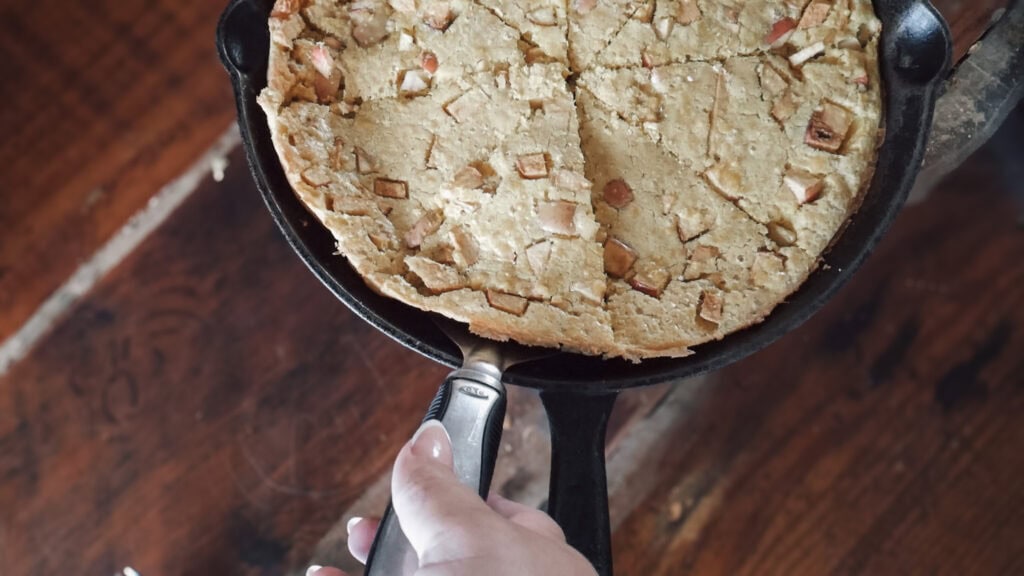
So today we’re starting in the kitchen with breakfast, and I’m going to have one of my younger kids help me make a puff pancake in a cast iron skillet. This isn’t really a formal cooking lesson, and I’m not expecting my child to walk away from this knowing how to independently make breakfast for the entire family. I’m simply inviting a child into something that I’m already doing.
There are so many basic cooking skills hidden inside a simple recipe. Measuring ingredients, cracking eggs, stirring, watching the oven, understanding heat, following directions, and cleaning up the workspace are all practical skills that will serve them throughout daily life.
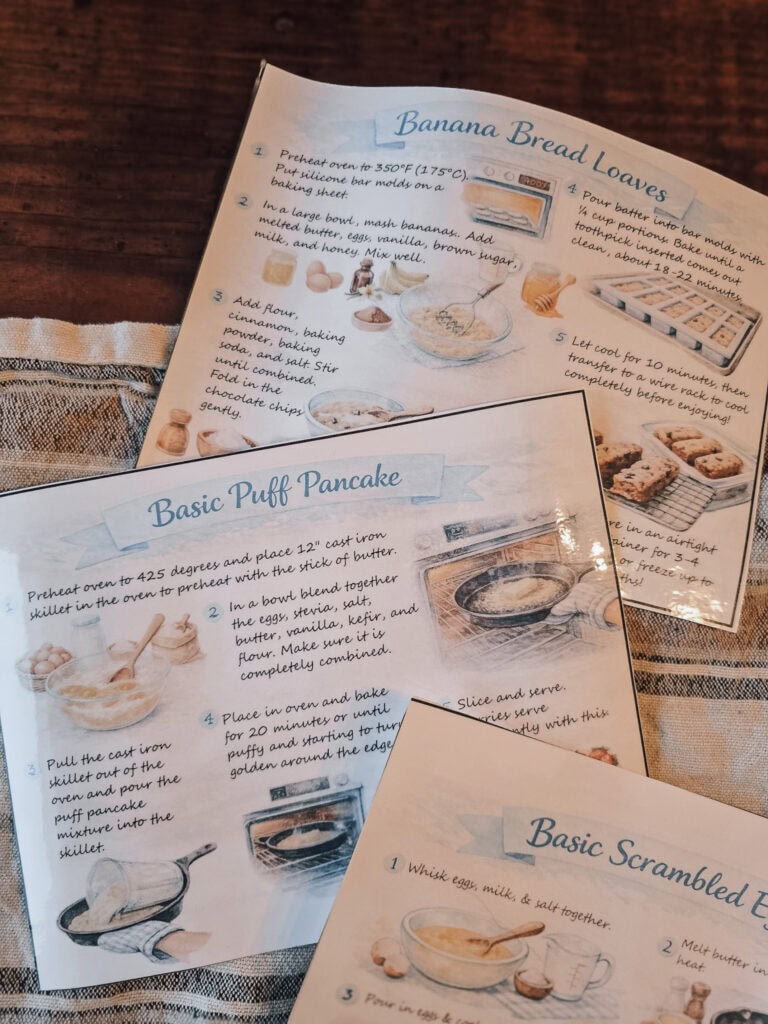
And this is actually where I’m going to use one of my visual recipe cards. I created these because I wanted recipes to be accessible to children who are still learning to read and follow directions independently, and I think they’re a great way to let younger children participate in the kitchen without making the recipe unnecessarily complicated.
And while we’re working with our eggs, I’m also preserving some for later.
We’ve been getting quite a few eggs because that’s this time of year with chickens, which is a great time to teach my boys to look at what we already have and think ahead. We have more eggs than we can use right now, so let’s preserve them for later; we have flour and pantry staples, so let’s think about what we can make with them. I want them to understand that the grocery store is a wonderful convenience, but it doesn’t have to be our first solution—we can be resourceful, use what we have, and plan ahead for what we’ll need.
And there is even a funny little educational moment here because I’ve realized that some young people don’t actually know what butter is made from, or they think eggs are a dairy product because they’re found in the dairy section of the grocery store. Those little misconceptions are exactly why I love letting children see how things actually work.
Teaching Life Skills Our Ancestors Knew: Understanding Food and Nutrition
One of the things I want to teach my boys through these practical life skills is a little bit about how food actually works. Our ancestors had to understand where their food came from, how to prepare it, how to preserve it, and how to make the most of what they had. They didn’t have the same convenience we have today, so understanding food was simply part of daily life.
I’m not trying to recreate pioneer life in my kitchen, and I certainly don’t think everything our ancestors did was automatically better. But there is something worth learning from the knowledge they had. Many traditional food practices were built around simple ingredients, thoughtful preparation, and making the most of what was available.
One example is teaching my kids the difference between a sourdough starter and commercial yeast. They don’t necessarily need to become expert bread bakers, but I want them to have that light bulb moment of understanding what’s actually happening in the food they’re making.
I think that’s an important part of teaching life skills. It’s not just about completing a task; it’s about giving children enough understanding to make wise choices later in their own lives. When they understand ingredients, preparation, nutrition, and why we might choose one method over another, they’re developing critical thinking and learning how to make informed decisions.
And that’s really what I want these essential life skills to accomplish. I want my boys to grow up understanding that food doesn’t just magically appear at the grocery store, and that convenience isn’t always the only or best answer. I want them to be curious enough to ask questions, learn new things, and eventually become responsible adults who understand what they’re putting into their bodies and why.
The goal isn’t that they remember every recipe I taught them. The goal is that someday they can look at something unfamiliar and think, “Oh, now I understand how this works.”
Basic Cooking Skills for Kids: Making Butter, Bread, and Biscuits
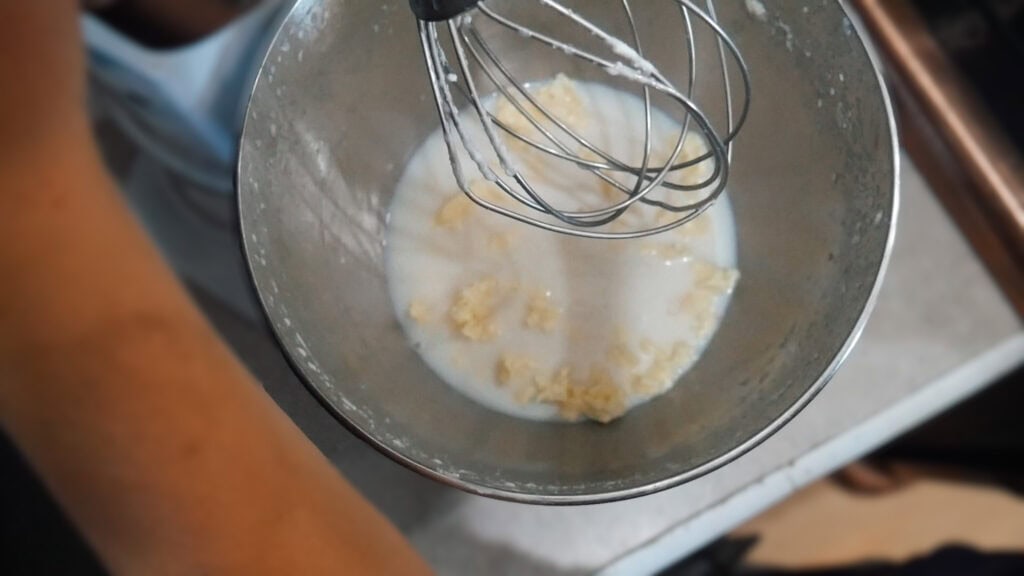
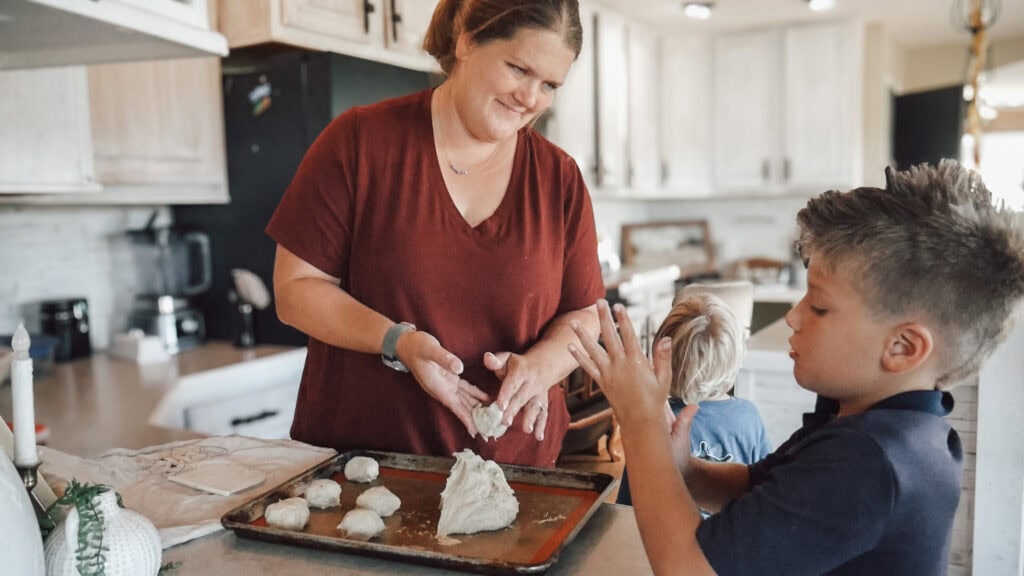
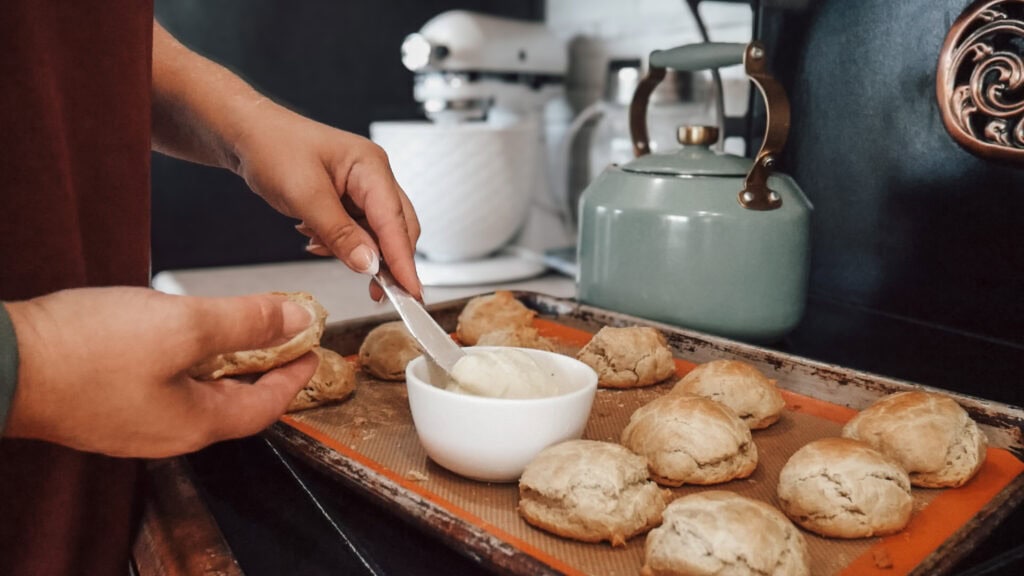
Later we’re going to make butter and sourdough biscuits together. I did the mixing of the biscuits ahead of time because I wanted them to ferment properly before the boys ate them for lunch. They’ve helped me in the kitchen before with breads and biscuits, so the butter was actually the highlight of our time together today.
I don’t necessarily care if my boys grow up and make homemade butter. I don’t care if they make biscuits from scratch or decide that homemade bread is worth the time. Those are choices they’ll make as adults. What I do want is for my boys to be comfortable in a kitchen.
I want them to know how to feed themselves. I want them to be able to follow a recipe, understand basic cooking skills, clean up after themselves, and serve food to someone else. I want the kitchen to feel like a normal place where they belong.
And I don’t want that simply because they’re boys who need to know how to survive without Mom someday. I want it because they are human beings who will someday need to care for themselves, care for other people, and participate in a household. A home is not a hotel where someone else is responsible for everything. Family life requires participation, and children can begin participating when they are very young through small tasks that grow with their age and ability.
And there’s another reason I want them in the kitchen: mistakes are allowed here.
If a biscuit doesn’t turn out, we can talk about why. If they measure something incorrectly, we can fix it. If they don’t know what to do next, we can look at the recipe together.
That’s part of critical thinking. Children need opportunities to practice making decisions, noticing mistakes, communicating what went wrong, and trying again.
You can’t learn those things simply by being told about them. You need a lot of practice.
What I Actually Want My Boys to Learn
When I think about the most important life skills I want my boys to have, I realize that my list looks a little different than I expected.
Of course, I want them to come away from our home with basic life skills, but underneath those necessary skills, I want to build something bigger.
I want them to love learning. I want them to be curious about new things and comfortable admitting when they don’t know something yet. Not knowing how to do something shouldn’t be a reason to give up; it should be an invitation to learn.
I want them to pursue excellence. Excellence doesn’t mean perfection, and it doesn’t mean every task deserves hours of attention. It means learning to take ordinary work seriously and doing what you’ve been given to do well.
I want them to be resourceful. Before spending money, I want them to stop and ask what they already have. Can they repair it, make it, reuse it, borrow it, research it, or solve the problem another way?
I want them to develop critical and creative thinking. I want them to look at a problem from more than one angle and have enough confidence to try something new. Those skills will matter whether they’re in elementary school, middle school, high school, or eventually navigating their own lives as young adults.
I want them to know how to participate in a household. The household isn’t Mom’s job that everyone else occasionally helps with. We’re a family, and each person has an important role.
And finally, I want them to know that they are capable of learning necessary skills. Whether it’s cooking, gardening, basic first aid, managing finances, repairing something, or learning something I’ve never even thought to teach them, I want them to believe they can learn.
What Can I Do With What I Have?
I think sometimes we make teaching life skills much more complicated than it needs to be. We can make enormous lists of everything our children should know by the time they leave home, but we can’t possibly teach them everything they’ll encounter in adult life. What we can teach them is how to learn, how to ask questions, and how to approach something unfamiliar with confidence.
That’s why I think everyday life is such an excellent classroom. We don’t have to manufacture a lesson for every skill; we can simply invite our children into the real work that’s already happening around us, give them small tasks, let them make mistakes, and gradually increase their responsibility as they grow.
Someday my boys will have their own homes, kitchens, budgets, problems, and responsibilities, and I won’t be standing beside them to answer every question. My hope is that when they encounter something they don’t know how to do, they won’t immediately think someone needs to sell them the solution. I hope they’ll look at what they have, ask questions, be willing to learn, and think, “I wonder what I can do with this?”
Because maybe that’s one of the most important life skills I can teach them.
Don’t Forget to Pin for Later!