
The Fruit of the Spirit goodness is easy to talk about when life feels like it’s rolling along smoothly, when our plans are going according to schedule, the kids are happily occupied, the garden is producing a colorful abundance, and the home feels peaceful. But when circumstances stall, when our desires seem delayed, and when God’s work in our lives feels more like pruning than blossoming, it can be harder to remember the goodness of God.
This is our last devotional in our Fruit of the Spirit for Moms series. I haven’t gone in the traditional order of these fruits. I’ve chosen them based on what I’m drawn toward that specific week. Surprisingly, this week, despite this fruit being my only choice, I have felt very drawn toward contemplating what goodness means in my life.

This page may contain affiliate links. To view my full affiliate link disclosure, click here. There are Amazon affiliate links in this post. As an Amazon Associate, I make a small commission from Amazon links in this post. Find our privacy policy, terms of service, and more information about user data by visiting the links above.
Other Devotionals in the Fruit of the Spirit for Moms series:
- Choosing Joy
- Peace in our Mothering
- A Mother’s Unconditional Love
- Biblical Patience: A Call to Moms
- Faithful to Our Calling
- A Devotional on Kindness
- Cultivating Self-Control
Watch the Fruit of the Spirit for Moms devotional series on YouTube.
I’ve had seasons where my prayers felt unanswered for months, maybe even years. Sometimes it was over big things—deep longings I had been bringing to the Lord faithfully. Other times it was small, daily hopes: that my children would listen the first time, that a project would come together quickly, or that the garden wouldn’t be overtaken by weeds again before I could get to it. But in each of those seasons, the Holy Spirit kept whispering to my heart: I am still good.
I never started Healing Home with the desire to make it into a platform or do the influencer thing. That wasn’t even a term when I started. My only hope as I pushed my stroller down our country road with my firstborn was that I could stay home someday and raise my babies. As I’ve faithfully pursued that goal, I honestly thought God would answer the deepest longing of my heart. But as many of you know, I still work an office job.

After seven years of trying to grow a business and it still not replacing my income, I’ve had the temptation to feel dejected. Do I just not understand the system? The algorithm? Maybe I’m just plain ole’ stupid, and I’m too stupid to realize it.
The Greek word for “goodness” in Galatians 5:22 is agathosune, which means “uprightness of heart and life.” This isn’t just doing “good works” that look nice from the outside; it’s a goodness that comes from the very character of God Himself. It’s rooted in His holiness, His faithfulness, His love. True goodness is not measured by a “good job,” well done, or the praise of people—it’s measured by whether our actions and attitudes reflect the image of God for the benefit of others.
When Goodness Feels Costly
There’s a quiet, hidden side to the fruit of goodness. It often shows up when we choose to act uprightly, even though no one will notice, or when we serve without expecting anything in return. It shows up in motherhood when you fold laundry for the tenth time that week, even though no one will praise you for it. It’s in the way you pause to truly listen to your child’s story, even though the sink is full of dishes. It’s in the whispered prayer you offer for a friend when you’d rather just scroll on your phone. It’s when God says repeatedly ‘no’ to the deepest desire of your heart, and you have to choose to still call your Lord ‘good’ and not to wallow in self-pity.
The goodness of God is never self-serving; it’s always oriented toward the needs of others, even if it costs us something. That’s why it’s so different from the world’s definition of “good.” The world’s goodness is often about appearing good. But the Fruit of the Spirit grows in the soil of humility—it seeks God’s glory, not our own.
To my finite brain, I cannot imagine anything ‘good’ coming out of my struggle with my work, home, homeschool, and business balance. Why would God not say ‘yes’ to raising my kids at home? Saying ‘no’ seems like the very antithesis of how I understand traditional homemaking and motherhood.
When life doesn’t progress according to our own desires, we face a choice: Will we still reflect God’s love and goodness, even in the waiting? Or will we allow frustration to harden our hearts? Goodness is often most evident when our plans are delayed because it forces us to lean on the Holy Spirit to respond in ways we could not in our own strength.

The Homemaker’s Garden of Goodness
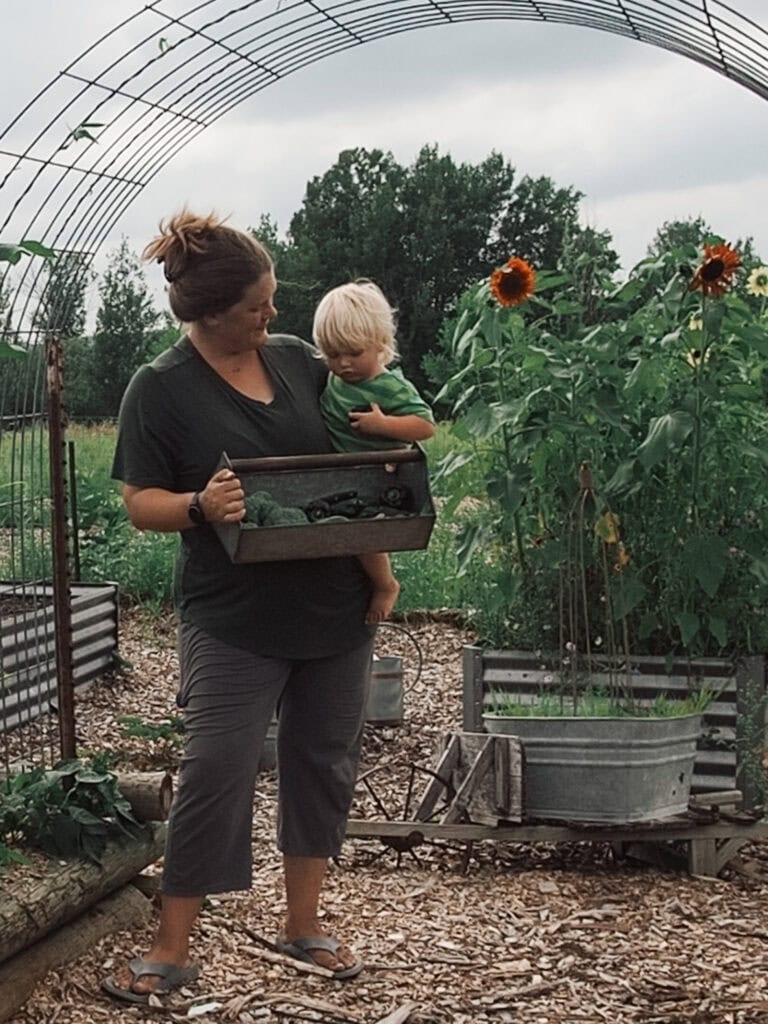
Homemaking has a way of teaching this. Every day I tend a garden—sometimes literally, sometimes figuratively. I pull weeds, water seeds, and wait for God to bring the growth. Sometimes I harvest cucumbers and broccoli (like I did this week) for my kids’ afternoon snack; other times I battle blight, pests, or a season of drought. In the same way, the Lord is tending the soil of my heart.
Just like I don’t always understand why one tomato plant thrives and another struggles, I don’t always understand why one prayer seems quickly answered and another remains in God’s waiting room. But just as I trust the sun will rise tomorrow, I trust in God’s goodness, that He is working for my benefit, and for the benefit of others, in ways I can’t always see.

When I hand my child a fresh slice of cucumber from the garden, it’s not just about feeding them something healthy. It’s a picture of the fruit of goodness—providing something nourishing, something that will help them grow. That’s what God’s goodness does for us. It nourishes our souls and equips us to nourish others.
Trust me, my kids have no idea the amount of work that goes into that tiny cucumber, or that in comparison to the ones at the store, the ones I slice from our garden are healthier and much better for their growing bodies. I think the same is true with our Heavenly Father. We have no idea the goodness he is pouring out on us. But in the same way that cucumber is nourishing my little boy’s body, the invisible goodness that God is pouring out on us is working to sanctify our lives in ways we cannot comprehend.
Cultivating the Fruit of Spirit Goodness in Our Own Lives
If we want the fruit of the Spirit to flourish in our own lives, we need to cultivate it intentionally. Now, up until now, we’ve been doing some higher-level thinking. However, cultivating goodness in our lives requires practicality. Because remember the heart is desperately wicked. On our own, our instinct will not be to cultivate goodness.
The heart is deceitful above all things,
and desperately sick;
who can understand it?
Jeremiah 17:9 ESV
Here are a few ways I’ve been learning to cultivate goodness in the everyday chaos of motherhood and homemaking:
- Stop Before Acting
Before I jump to fix a problem or give advice, I try to pause. I ask myself:- Is this choice rooted in God’s word or just in my own comfort?
- Is my motive love, or am I hoping someone notices how “good” I am?
- Would God consider this truly good in His eyes?
- Pray for Discernment
I’ve learned that prayer isn’t just for emergencies. When I ask the Holy Spirit to guide me moment-by-moment, I can sense His leading in the little things—whether that’s pausing to encourage a child instead of correcting harshly, or choosing to speak gently when I feel stressed. - Trust in God’s Work
The hardest part of goodness is trusting that God’s work is still unfolding even when we can’t see it. Like St. Augustine prayed, “Lord, you have made us for yourself, and our hearts are restless until they find their rest in you.” Resting in Him means believing His goodness is constant, even when our circumstances are not. - Renounce the Small Evils
Sometimes goodness is as simple as choosing not to gossip, not to grumble, not to snap back in irritation. These small renunciations clear space for the Holy Spirit to work in our hearts. - Grow in Virtue Daily
Goodness is not a one-time choice; it’s a daily practice. It’s in the laundry, the meal prep, the school lessons, the neighborly conversation, the small sacrifices we make to show God’s love.

A God Who Is Always Good
A favorite verse to cling to in the waiting is Psalm 23:6:
“Surely goodness and mercy shall follow me all the days of my life, and I shall dwell in the house of the Lord forever.”
I also think that 2 Chronicles 20:12 is simply breathtaking when we really allow it to sink in.
“We don’t know what to do, but our eyes are on you!” 2 Chronicles 20:12 ESV
I wrote an entire article centered around 2 Chronicles 20:12 during a time in my life when God was calling me to surrender. You can read more about it here.
The goodness of God is not something we have to chase—it follows us. It’s woven into every sunrise, every answered prayer, every meal provided, every moment we’re sustained through His Spirit.
Even when life feels stalled or dreams feel delayed, we can anchor our hearts in this truth: God’s goodness is not dependent on our timeline. His goodness flows from His very nature; unchanging, unshakable, and unending.
So today, whether you’re folding laundry, pulling weeds in the garden, or working through homeschool lessons, remember that the Fruit of the Spirit: goodness is not about perfection. It’s about letting the Holy Spirit shape your heart to reflect the uprightness of Christ. It’s about trusting that His goodness is present in every circumstance, even when we can’t yet see the harvest.
Let’s be women who, smitten with the fruit of goodness, let God’s love spill over from our lives into the lives of our families, our neighbors, and even strangers we meet. May we walk in uprightness of heart, confident that the God who began a good work in us will bring it to completion, in His time, and for His glory.



Don’t Forget to Pin for Later
